
But it is desire that creates talent."
-Bruce Lee.
 110mm film camera.
Hi My name is Hans Gonzalez, from The Golden Mile Productions at thegoldenmile.net Today I want to talk you about the different photo camera types out there for those of you that are looking to buy a good camera, or thinking in getting a better one.
I attribute my interest in photography to my mother, Rosa (Angela) Gonzalez. When she married my father in the Dominican Republic back in '68, she was only fifteen years old. They had four children; Maribel ('69), Biembenida ('71), me ('73) and Rosangeles ('79). In those days, it was customary for parents to take their young children to the photo studio and have their pictures taken. My mother did it every year. We all had big photo albums filled with lots of pictures. Some done professionally, the rest with a 110mm compact photo camera my mom owned.

Me, August 22nd, 1977 (110mm camera).
Like my mother, I also liked to take pictures. But most of my pictures were "I was here" pictures, or "Look at me" pictures. I was never interested in learning anything else about the medium, just to have a bunch of pictures taken, have the film rolls developed at the local 1 hour photo place, and an hour later be suprised by the results.

My two sisters March 10th 1979.
Biembenida (her birthday) on the left, Maribel on the right
My real interest in professional photography began by accident. In 2002, I started a small business on eBay, that's right, eBay! I quickly realized that my Sony Cybershot digital camera of 6 mp I had at the time was not producing the super clear pictures I thought I needed to sell my stuff. I began to think that my success heavily depended on the quality of the pictures I posted on the site. Therefore, I made it my mission to buy the camera that would allow me to do that!
I began investigating what made a great photo. I learned the many camera types that were out there and I discovered that what made a great photo was not necessarily having the best equipment, but rather a combination of things; a good quality lens, lots of mega pixels, and an understanding of light (I ended up getting an SLR).
All cameras are essentially the same. What makes one different from the other is the quality of some of its components, functions, pixel size, quality and size of their lenses and its ability for creative control.
A compact digital camera doesn't have the same functions and components that a professional slr has. There are three functions that can be easily manipulated using an slr: aperture, shutter speed, and iso. With the compact digital camera you won't be able to control them. In addition, an slr gives you the ability to buy different lenses. There are telephoto lenses, wide angle lenses, normal lenses, and these give you the ultimate creative control. The only advantage that a small digital camera has over an slr is its size; how easy it to use it and carry it. Imagine if everybody had slr bodies hanging from their neck at the bar, that would be a funny thing to watch.
The three functions that all cameras have and that can only be manipulated in the slr and some prosumer models are aperture, and shutter speed and iso. Aperture refers to how wide the lens opens at the time the picture its taken. A camera functions the same way we perceive things. The light that is reflected in the subject reaches our eyes and is recorded in our brains. The camera records its images in its sensor or film, and aperture basically means how wide the lens opens so that enough light reaches its sensor or film plaque. This is measured in f stops. f1, f1.2, f2.8, f4, f5.6, f8, etc. Shutter speed refers to how fast the lens open and closes. The longer a lens remains open, the more light reaches the sensor. The ability to manipulate shutter speed gives you the freedom to great pictures at night using a tripod. ISO refers to film speed. Remember those days when the film rolls were sold as 100, 200, 400, etc? a 100 ISO was the cheapest film roll and it was only good to take pictures in bright day light. 400 was good for night time. The same is true in digital. But with digital, you can easily control the ISO from 75-15000 and even more.
Megapixels! the more the better. With 12mp you can have prints made up to 20x30.
The three digital camera categories are referred to by retailers as consumer, prosumer and professional.
Consumer cameras are the small cameras that most people have and take the most pictures with. (they replaced the 110mm and 35mm compacts of the 70s and 80s and early 90s.) They are great because of their compact design and ease of use. Most people are satisfied with how they work. There are hundreds of styles and brand names out there, however they are all essentially the same. The only difference is that some have better glass (lenses) than others, and/or more pixels.
The disadvantage of these cameras is that they give their user very little creative control, the size of sensor is very small (less than 35mm), and often lens is of poor quality. Price ranges: $100-350.
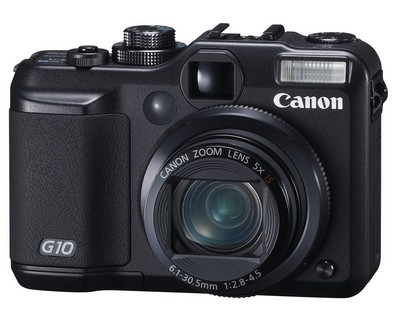
Prosumer (professional consumer).
The glass elements used to make prosumer cameras allows the person taking the pictures be a lot happier with quality and clarity of his shots. Some have most, if not, of the functions of a professional camera and can give his or user a greater creative control. The only cons of these cameras is their sensor size is still similar in size than consumer cameras (smaller than 35mm), a fixed lens, and a higher price tag (Around $500).
In the professional category we find a whole new set of cameras. But I am going to only mention just a few. The well known SLRs, medium format, and large format (often referred to as view camera).
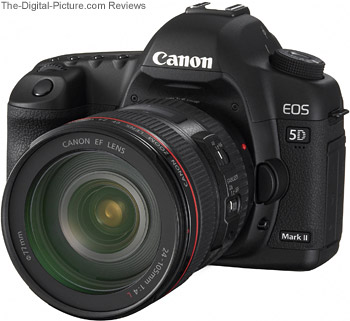
Professional Canon SLR.
SLR refers to Single Lens Reflex. What that means is that what you see through the viewfinder is what the sensor is seeing. Back in the 90s, compact film cameras came with a viewfinder that was separate from the lens (no one seemed to care the anyway). These cameras are very popular among professional photographers because they allow the greatest creative control and because their lenses can be interchanged. In professional grade SLRs, the sensor (film size) is often the same as that of the film SLR: 35mm. Other slr have a slighty smaller sensor and that is reflected in the starting price.
Nowadays (2011) A professional SLR has at least 21mp and a semi-professional has 12mp -18mp.
It doesn't necessarily matter what brand you buy. The most popular brands on the market today are Canon and Nikon. They are popular because both have the widest selection of lenses to choose from. Price range: $700-$7500.
Medium format and Large Format are exclusively used by the professional photographer with his or her own studio. To give you an idea, a digital medium format camara cost around $15000-$45000 thousand dollars. They call it medium format because of the size of the sensor. Usually 2x4 inches. Essentially huge. They have at least 30-50mp and can produce huge prints. The only drawback is the huge price tag.

Medium Format SLR.
Large format are used mostly for architectural and commercial photography. They are huge in size and are rarely seen outside the studio.

Sweet Lady
2006 Moca, DR
If you want to take better pictures on your own, please remember that what makes a great photographer is not having the greatest of camera bodies, but the ability to see and capture great moments, understanding of composition, and thorough knowledge of light. The next time you see a great photograph, ask yourself what makes it great, and the answer will surely come.

The Cloisters, NY
One of my first pics with an SLR.
I hope you found this information useful. If you want to see more of my work, please visit us http://www.thegoldenmile.net. For questions, comments, or to book your appoitment, email us at thegoldenmile@gmail.com or call us 917-539-9418.
Thanks for reading.
Hans Gonzalez


